Revisiting the Master System games from my childhood (Part 1)
Sunday, May 17, 2026My introduction to console gaming was at my grandparents’ house. I’m not sure how old I was — maybe 5? But my grandfather, who always loved technology, had a Sega Master System, and one day he was looking after me and introduced me to it. I’d played games on the family’s Acorn computer before, but never a home console. The selection of games he had was a bit random. Most of them don’t seem to be regarded as classics of the system, but I played the heck out of them. I don’t think I ever finished one though! Still, I have many fond memories of playing while my grandfather watched. Now that I have a retro handheld that plays Master System games, I’m revisiting the 10 or so games I used to play all the time to see how they hold up today. I’ll review the games over three posts, starting with…
Air Rescue (1992)
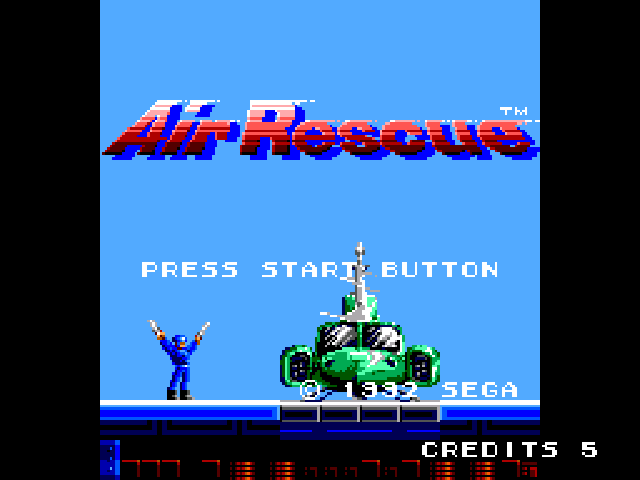
I remember this one being tough as nails when I was a child — my grandfather also thought so. This time around I was able to finish it on my second attempt. My conclusion is either I used to be terrible at the game, or, more likely, the D-pad on our Master System controller absolutely sucked. This side-scrolling action game is about piloting a helicopter, shooting terrorists, and rescuing hostages. Each level has a required number of hostages rescued to progress (6 or 7), and you can carry up to four at a time. This was considered quite a “mature” game by my family and while I was never quite banned from playing it I remember there was a bit of discomfort around little me shooting terrorists.
The helicopter has inertia, which is your biggest enemy by far — most deaths will be caused by being unable to stop in time to avoid an obstacle or enemy. Thus it’s all about finessing the controls and never rushing. The game has only 5 levels, and the final one is a significant difficulty spike, as it is through a cave network with ample opportunity for crashing into the ceiling or walls as you dodge enemy fire. The crazy thing is I don’t think I’d ever even seen this final level until I played it for this post, so difficult was controlling the chopper on the spongy, wobbly D-pad.
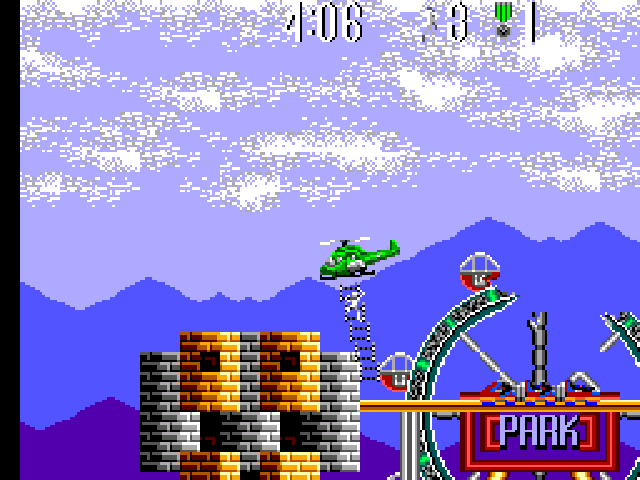
The two buttons are used to fire your weapon or lower your rope ladder (which swings pleasingly as you move left and right). You have a choice of 4 weapons/tools that can be changed from the helipad, but only 2 of them are worth using — a horizontal machine gun and a kind of forward-down launching bomb.
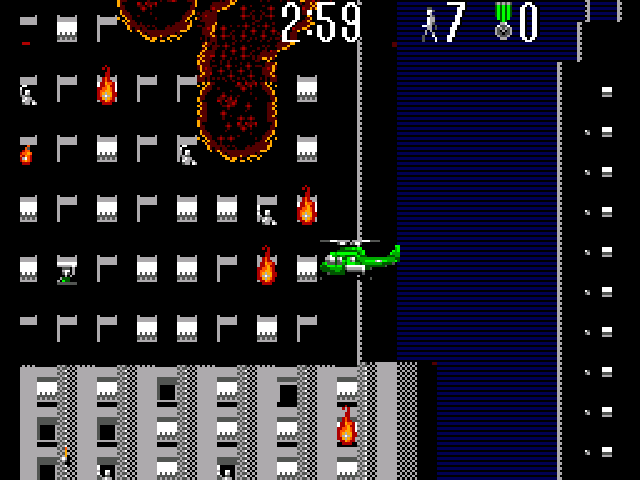
Overall, the game looks decent, with a cool title sequence and the helicopter nice and detailed with its swinging rope ladder. Level 2 stands out for it’s verticality (a skyscraper rescue), and level 5 for its difficult cave manoeuvres. The first level is a fine introduction. The remaining two are just filler really, which is a shame when the game is already so short.
Asterix (1991)
This one is closed to my heart as I spent a lot of time with it as a child. I’m pretty sure it was my first exposure to Asterix, and I ended up getting really into the comics and animated films. Even had several of the large plush toys they made of the characters, some of which were gifts from my grandfather.
The objective of this game is to rescue the druid Getafix (one of my big plush toys) from the Romans.

I remember this game being long and difficult. Well, the game gives you unlimited Continues, but without the capability for saving progress I was never allowed to play for long enough in one sitting to actually see it through to the end. The game has 20 levels, though they’re relatively short, and you can choose to play as Asterix or Obelix in each one. Asterix is smaller and more nimble, able to fit through some gaps that Obelix can’t. Obelix can break blocks with his fist, head (like Mario) and with his butt-stomp attack. Each level has an Asterix version and an Obelix version, tweaked to suit the abilities of each character, which is quite nice because you can switch to the alternate character and level if you’re getting stuck.
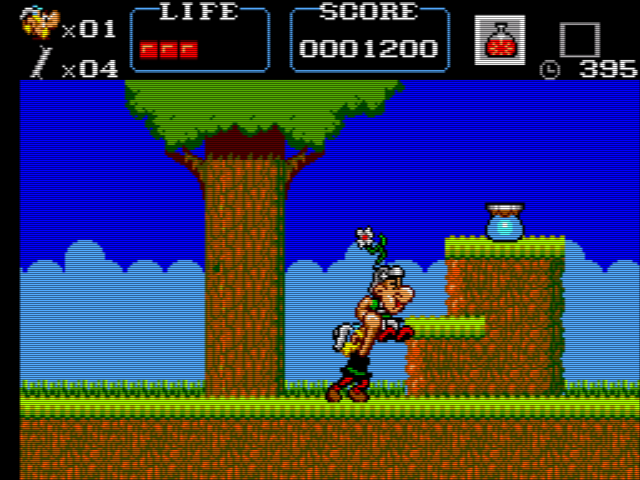
Like many games of its time, the levels are a grab bag of platformer tropes — moving platforms, lava, ice, quicksand, autoscrolling, underwater, avoiding stuff falling from the sky — which vary highly in level of frustration caused. Some levels are fun. The autoscrolling and underwater levels are the worst. One of the underwater ones has you avoiding obstacles while being periodically plunged into total darkness, and also has the most “screw you” mechanic ever — sometimes swimming off the bottom of the screen transitions to a new screen, sometimes it instantly kills you. These two possibilities exist side-by-side, are indistinguishable,[1] and finding the non-fatal transitions is necessary to progress. The early levels also have bosses, but this is for some reason abandoned by the halfway point.
Liking the characters and IP goes a long way as a kid, even though most of the action has little connection with the source material. The most obvious thing missing is the magic potion — the source of Asterix’s strength.[2] You could explain the absence in the game as “Asterix has no magic potion because Getafix has been abducted by the Romans”, but it’s not that you don’t find potions in the game — you find plenty, but they’re used for throwing to have various effects on the environment (such as exploding blocks, creating platforms, and so on). It would feel so much more like an Asterix game if you could find a magic potion that gives temporary superpowers like the star in Mario.
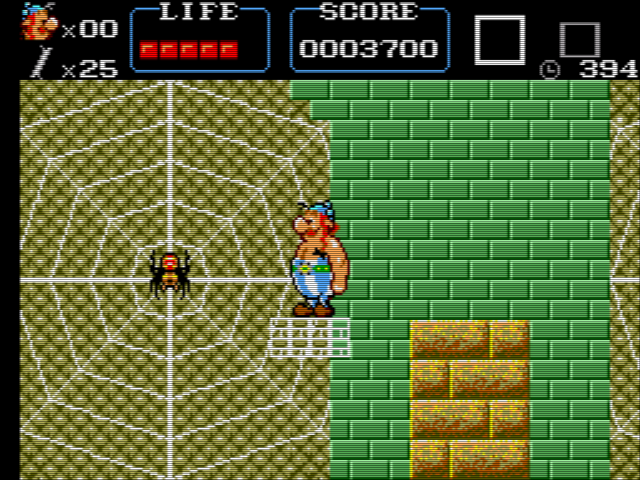
The sprites look decent enough, and the music ranges from catchy to irritating (the cheerful ones are nice, all the ones that try to sound perilous just sound shrill). The music for Obelix’s opening level works nicely for his bumbling, oafish character. Overall there are some fun bits but I’m glad I could put it down and save it when it got tedious. I sure wouldn’t enjoy having to play this whole game in one sitting.
Sonic The Hedgehog (1991)
Virtually forgotten in the shadow of its Mega Drive version,[3] the Master System version of Sonic The Hedgehog deserves a little respect, if not love. Some real care went into bringing the Sonic experience to an 8-bit console. My grandfather never really cared for Sonic, preferring his predecessor as Sega’s mascot, Alex Kidd.
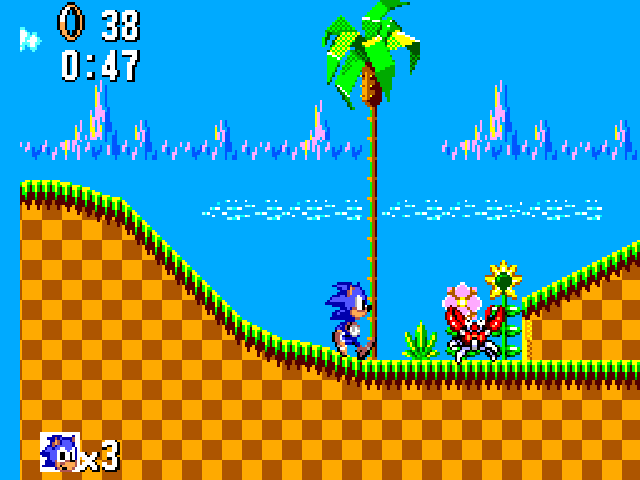
After the very slow and rigid platforming of Asterix, the speedy and smooth movement of Sonic was hugely refreshing.
On first booting this game, I was struck by two technical points. Firstly, being from a PAL region I had only ever played the game at 50Hz. On my retro handheld the game runs at 60Hz (as it would have done in North America), 20% faster than I was used to! So while Sonic on Master System would never be as fast as Mega Drive, it still felt pretty quick and not as painfully slow as I remember. The other thing I noticed was a lot of stutters and lag. At first I thought it was my device, and started trying to tweak settings to fix it. Turns out that no, the original also had a lot of stuttering and lag, but my little 7 year old brain was able to easily tune that out.
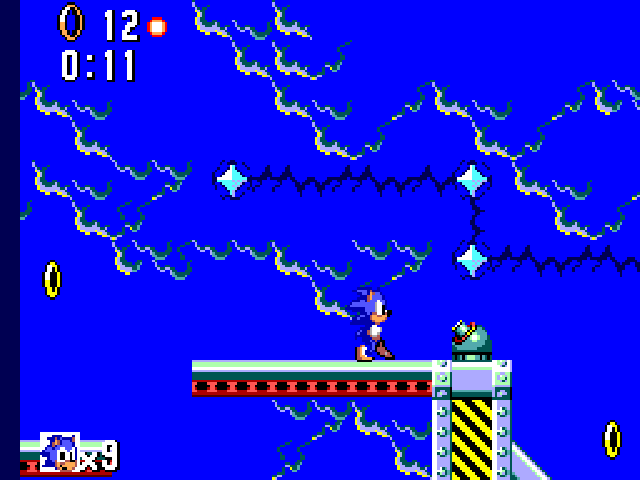
Anyway, what can I say? It’s Sonic, we all know the deal. Apart from being overall simpler and slower, the most noticeable missing gameplay feature in the 8-bit version is that Sonic can’t recover his rings after getting hit — the system just wouldn’t be able to handle animating all those rings. We get simplified versions of some levels, as well as some levels that are unique to the 8-bit version. The special zone is also noticeably simpler, basically a big course lined with springs and pinball bumpers to bounce through collecting rings, rather than the Mega Drive’s rotating level.
I have to admit, even though this game had a reputation for being short and easy compared to the Mega Drive version, I sure don’t find it easy, so I used a cheat code for unlimited lives in order to actually see the later levels I never reached as a kid (I never got beyond Labyrinth (zone 4), and usually got stuck on Jungle). The level design definitely still holds up today, with lots of quite precise platforming sections to make up for the lack of speed, size, and complexity forced by the low-powered Master System, and there are a couple of levels that are more maze-like and puzzly.
Anyway…
See you next time for some more 8-bit fun.
Possibly there is a way to tell, but it would be based only on recognising exactly how close you have to be to the edge of the screen to trigger a transition vs. dying. ↩︎
In the comics, Obelix is strong because he ingested enough potion as a baby to be permanently jacked, but Asterix gains superhuman strength in bursts by sipping from his supply of Getafix’s magic potion. ↩︎
Especially in North America, where it released right before they stopped selling Master Systems. ↩︎